Information Architecture-based Design
Website Design
TIMEFRAME 12 WEEKS
ADVISOR STEPHANN MAKRI, INFORMATION ARCHITECTURE MODULE
ROLE DOMAIN MODEL, SITEMAPS, USER-journey, WIREFRAMing, USER TESTING
TOOLS Adobe xd, DRAW.IO, CARD SORT & TREE-TEST (OPTIMAL WORKSHOP)
INTRODUCTION
Information delivery has surfaced as a major challenge across public and private services in the light of the recent pandemic in India. Nationwide precautionary measures in response to the pandemic brought several forms of economic activities to a halt. This adversely impacted the street vendors in Indian cities due to disruption of their livelihood and delays in the impending formalisation of their occupation.
Recent implementation of legislations geared towards formalisation of vending activities have become critical for the potential beneficiaries to follow up with. Associated non-government organisations proactively aggregate government publications and news, interpret the implications, and share them with street vendors through multiple channels. The enactment and implementation of the legislations, however, have varied in their progress across different provinces and cities. This has added to the challenge of keeping track of developments and accessing contextually relevant information. Additionally, the central and provincial governments have extended several financial schemes and upskilling workshops that have varying criteria and timelines for enrolment.
AIM
The discussed developments necessitate requirement of a dedicated information environment that can:
Organise multi-faceted information in a comprehensive way
Provide contextually relevant information to the end-user
Facilitate functions of public institutions and NGOs such as outreach, registration, and up-skilling of street vendors
Enable personalised consultation in the longer run
The project collates critical informational requirements and touchpoints for street vendors and associated institutions and speculates an information environment (in the form of a website).
PROCESS

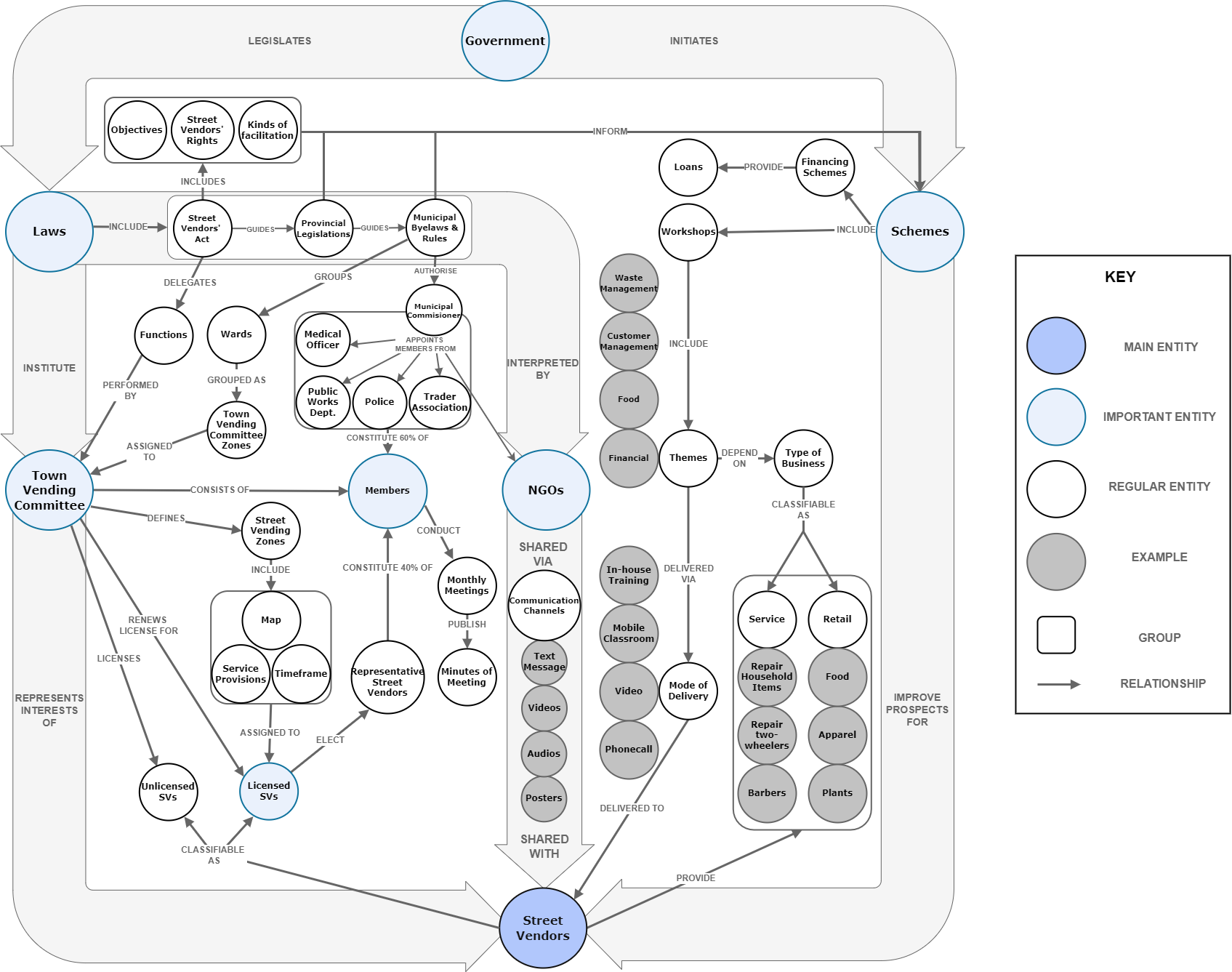
DOMAIN MODEL
A domain model was prepared to map critical ideas identified through research. Research for the concept model involved interviews with three domain experts, study of Street Vendors Act (central legislation), Delhi Street Vendors Rules, 2016 (provincial legislation of Union territory of Delhi), and Notifications by State Gazette and Municipalities of Delhi; and progress reports on state-wise implementation of the central state and municipal legislations.
The Domain Model served as a visual aid to communicate the important entities and their inter-relationships and hierarchy such as:
Critical informational touchpoints (such as key legislations, associated documents, classifications),
Institutional hierarchy (including composition, demarcation of authority, and area of jurisdiction),
Functions and schemes of institutions/third-party services in relation with street vendors (such as information delivery, licensure, workshops etc.)
SITE MAP
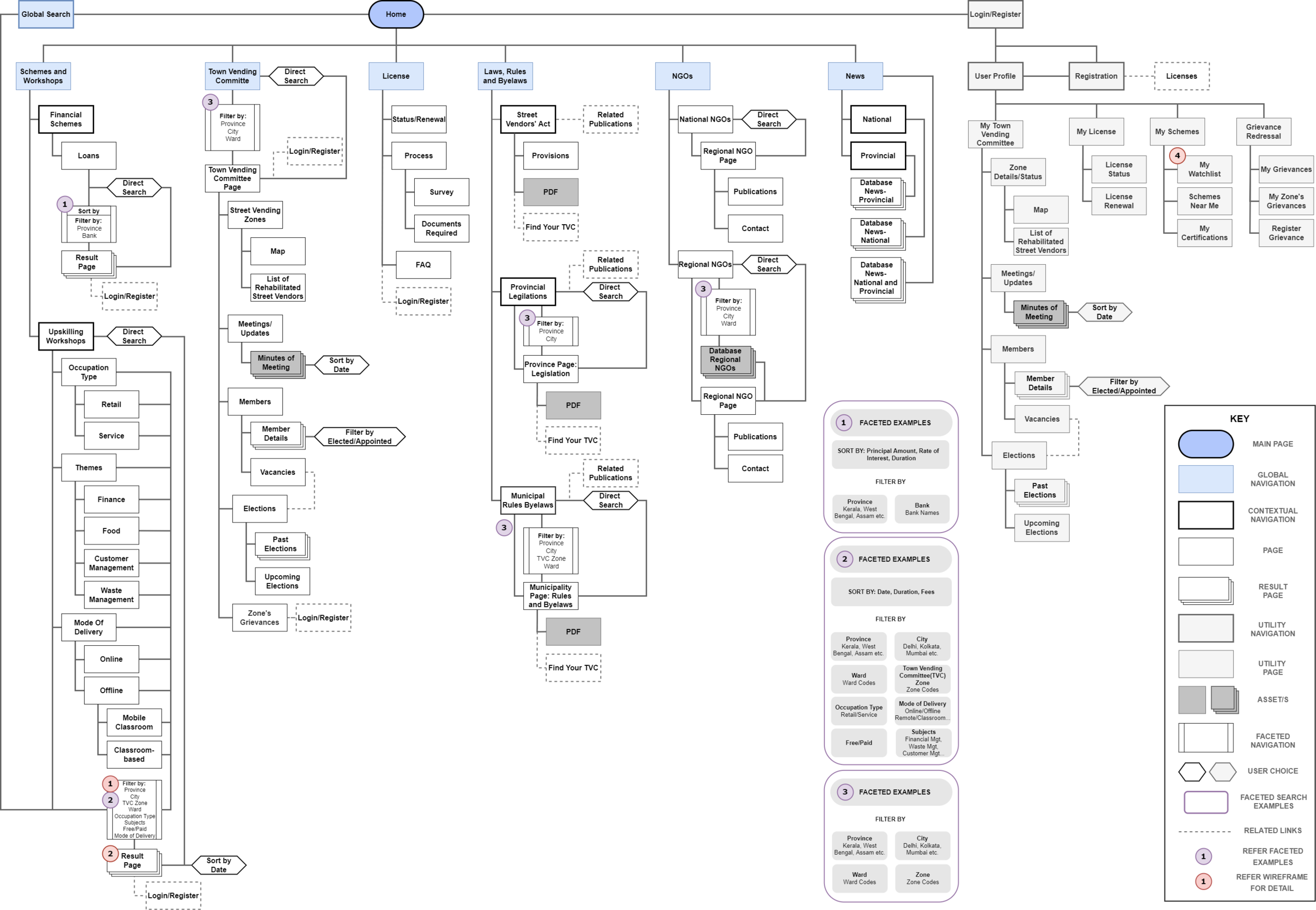
The sitemap uses colours and outlines to depict hierarchy and related links.
It includes a home page, global search, tabbed navigation that integrates global, contextual, and utility navigation.
The global navigation includes six key verticals (i.e., six groups of nested pages) identified as critical informational and functional needs for the target audience.
The utility navigation bypasses the need to browse or search within the main website through personalised information for the registered user.
The integration of contextual navigation in a tabbed view helps user keep track of selections made while browsing without loss of context.
USER TESTING (LABELLING AND HIERARCHY)
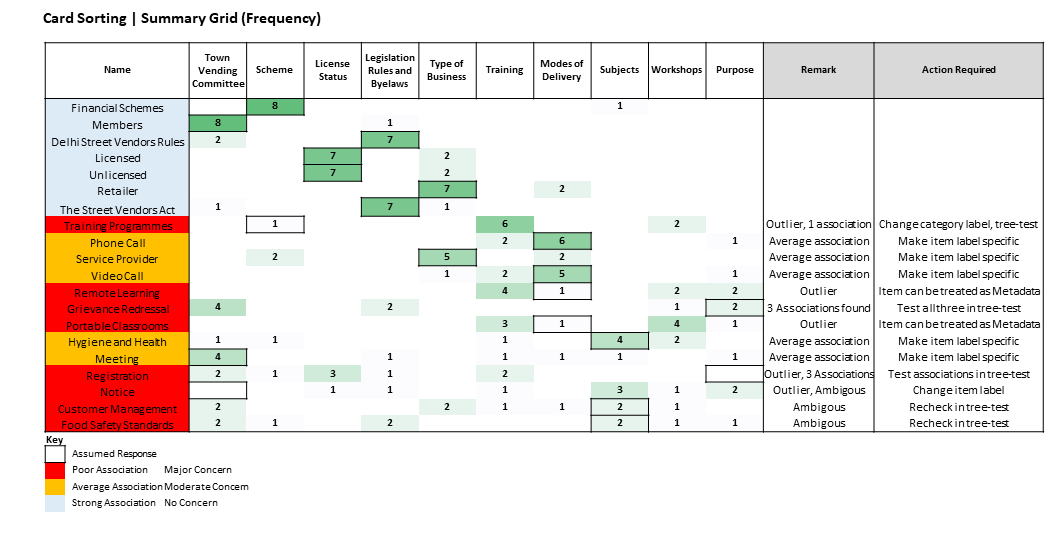
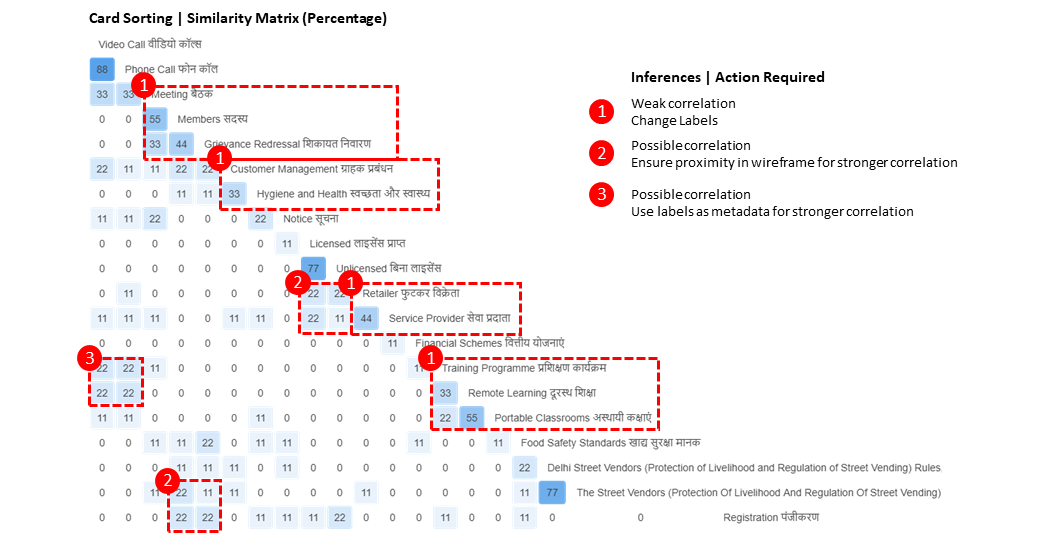
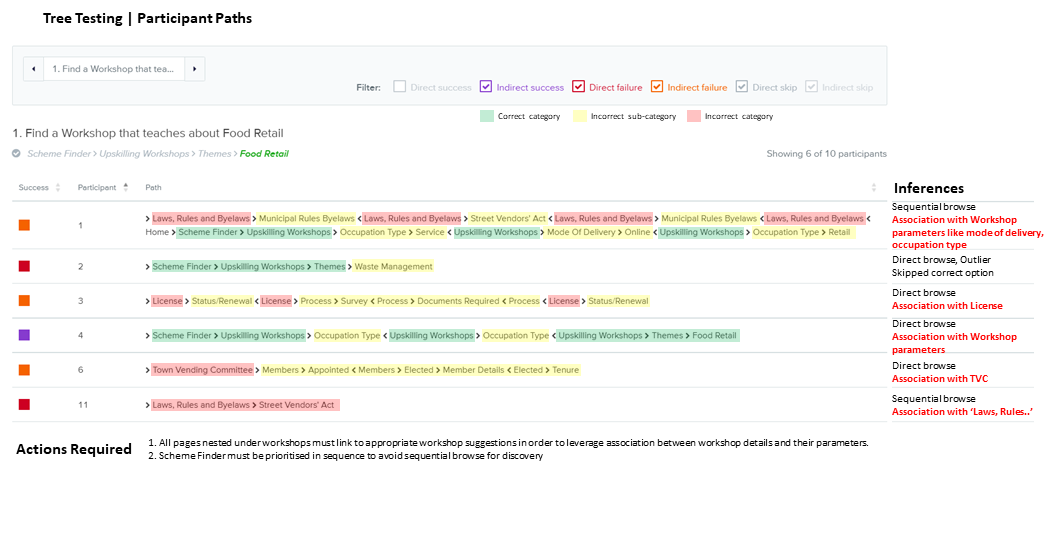
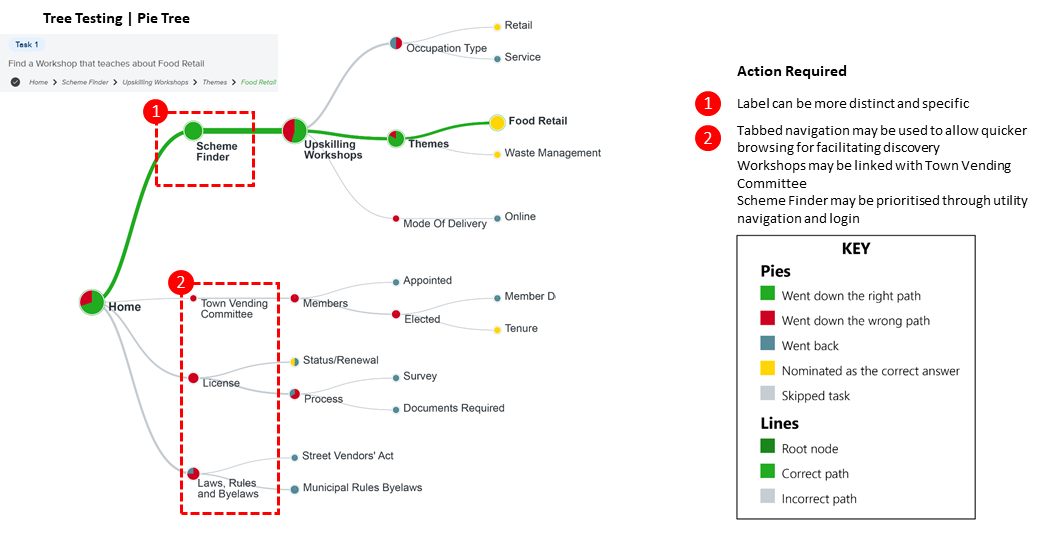
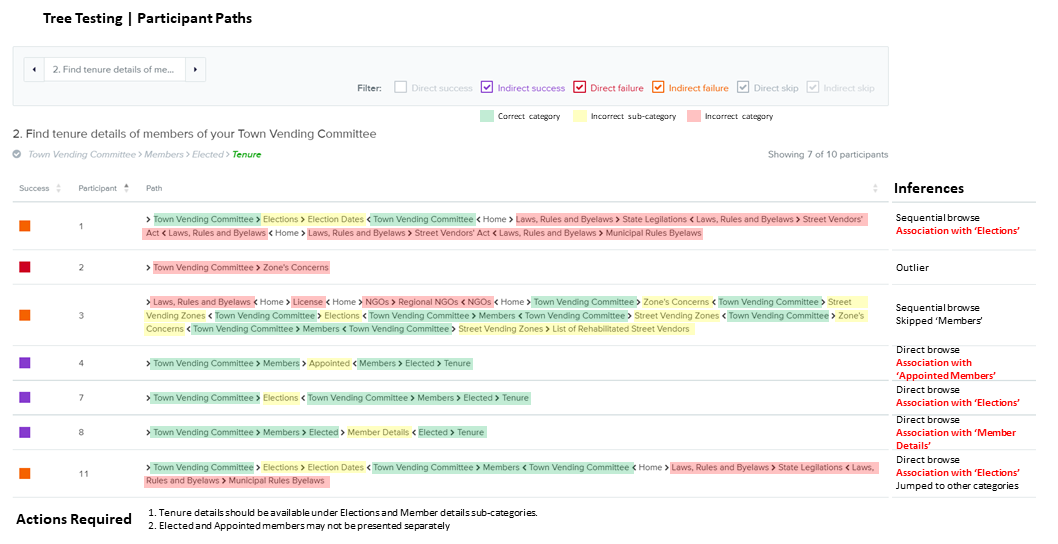
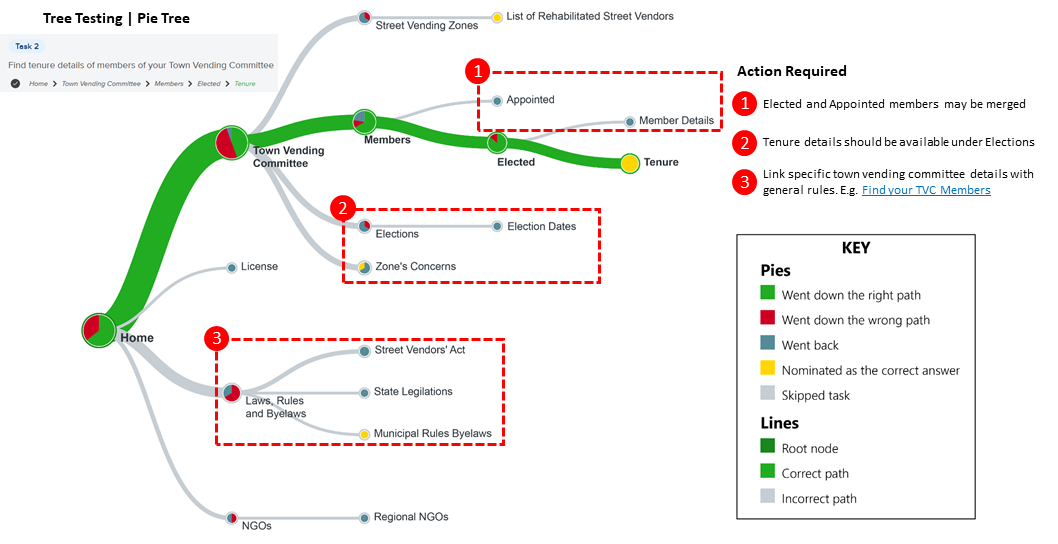
The labels and hierarchies established in the initial stages of the sitemap were tested via unmoderated hybrid card sorting and tree-testing (conducted through Optimal Workshop).
Both tests were floated among domain experts and government ward-level surveyors who were unfamiliar with the domain. This was done to check for thoroughness as well as intuitiveness of the labels and hierarchy proposed. This also ensured the testing was focused on persons with familiarity to online websites for data-entry, consultation, and surveys. The tree-test involved the two critical informational requirements i.e., finding information about the user’s town vending committee (such as constituent members, elections, updates etc.), and finding a workshop to enrol for.
USER JOURNEY
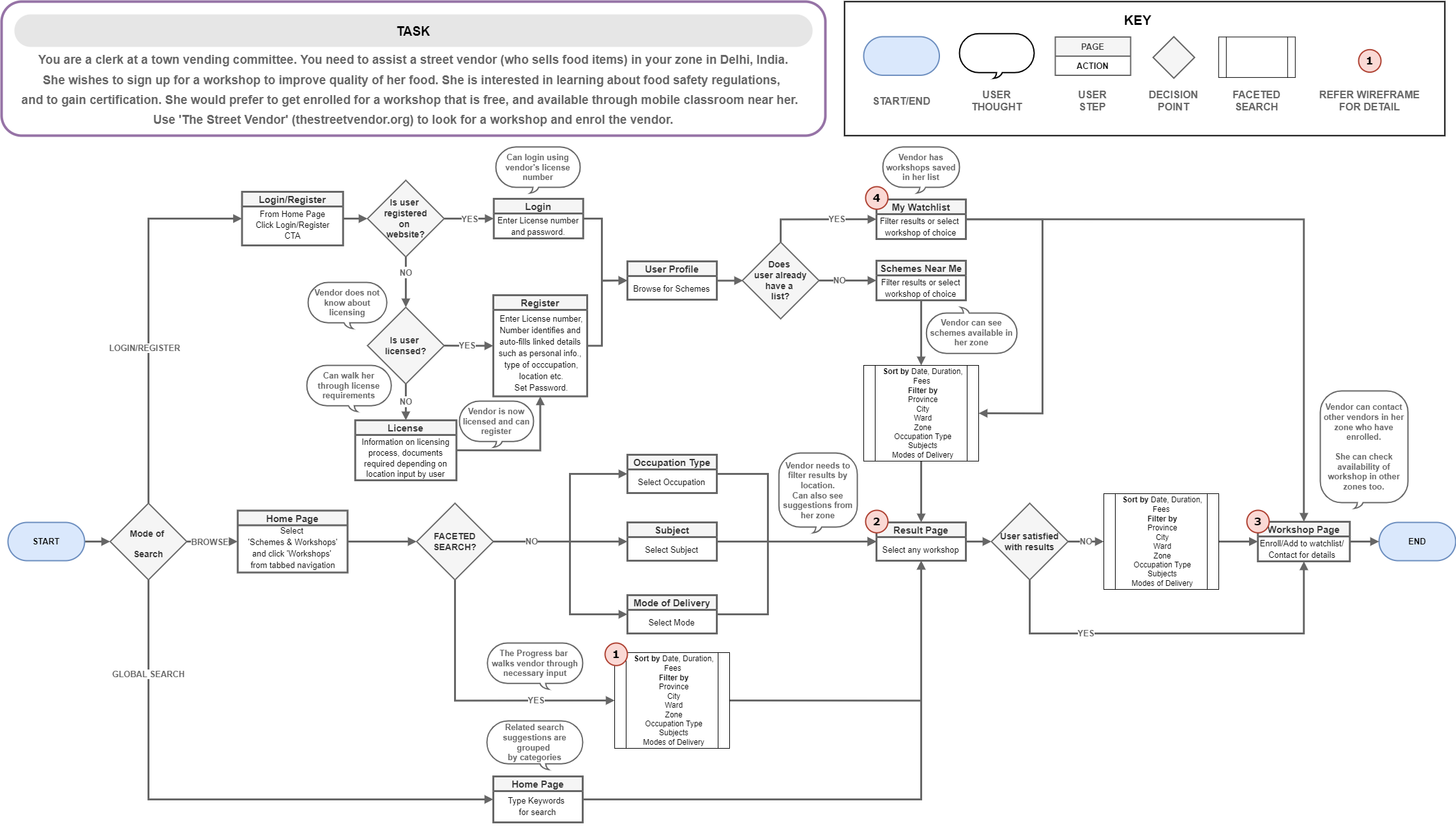
WIREFRAMES
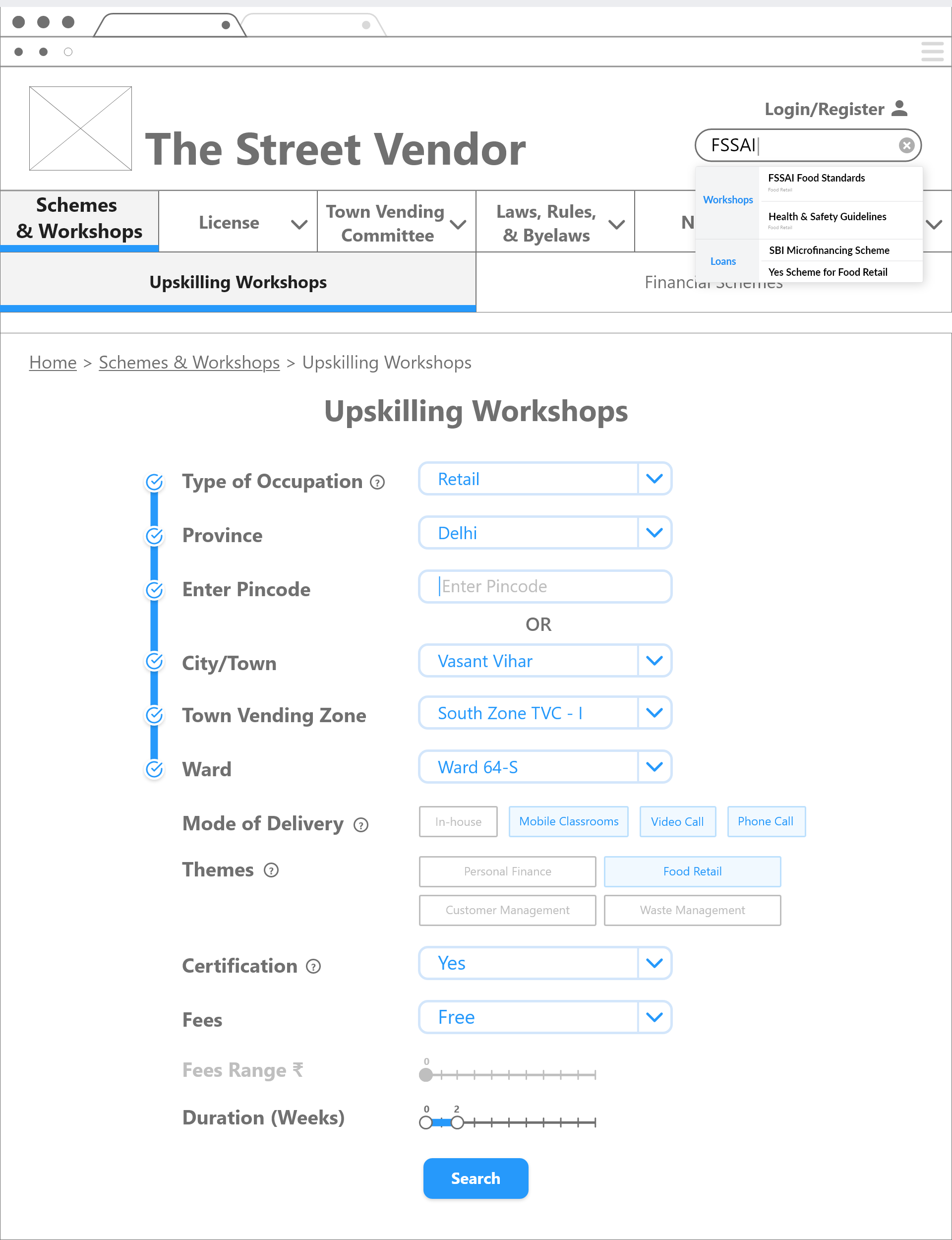
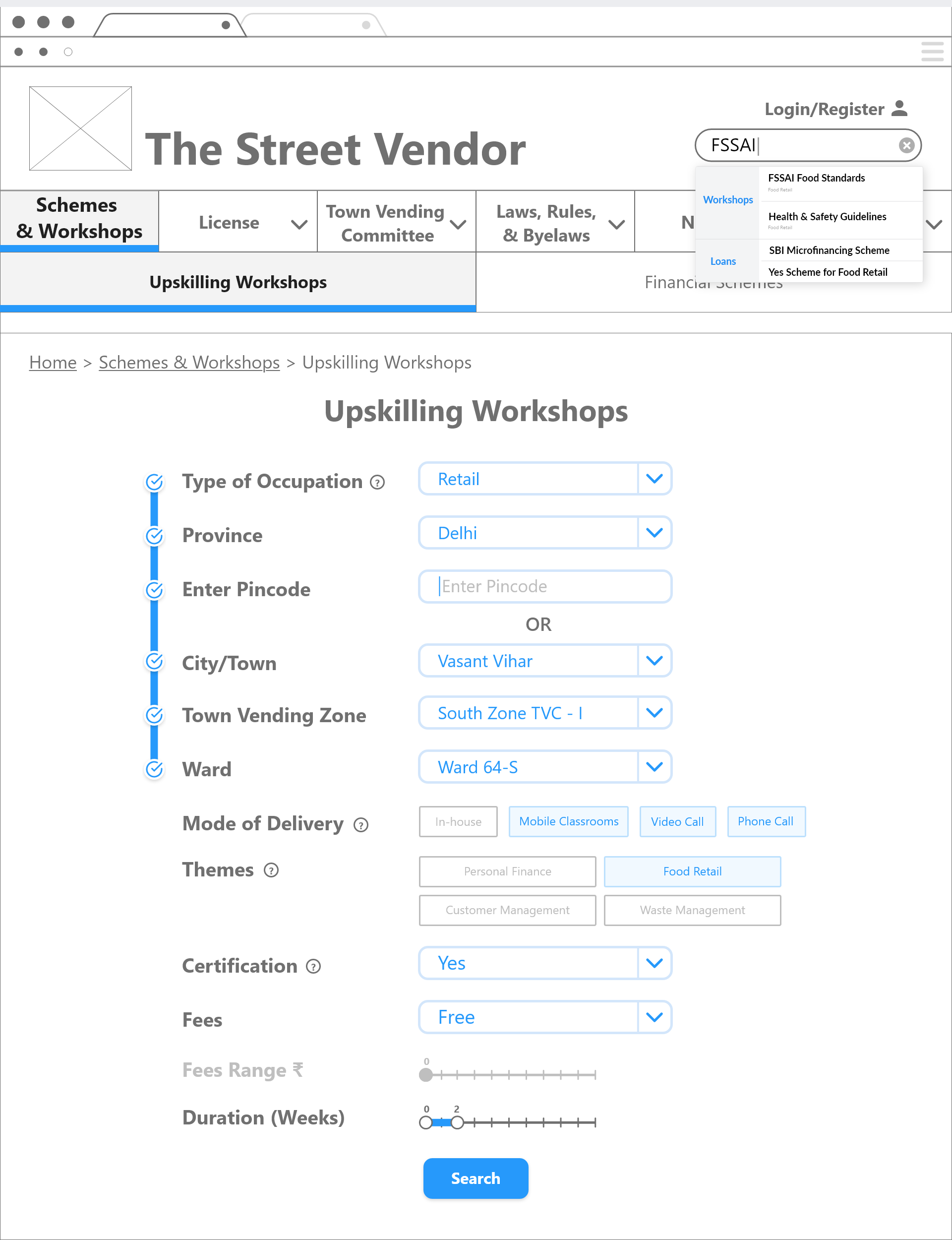
Wireframe 1 | Faceted Navigation
‘Upskilling Workshops and ‘Financial Schemes’ have been designed to be primary means of search. Wireframe 1 depicts the former in detail. The page aims to collect locational, occupational, and preference-related information to return suitable results. The design evaluation helped understand the need to bypass multiple fields and distinguish necessary input from that which may be optional.
As location is key for listing accessible workshops, a progress bar has been provided to cue the user to input the same. The design also allows manual entry of pin code that bypasses the need to enter user’s city/town, town vending zone and ward. This is a crucial intervention that leverages the numerical literacy of street vendors (Srivastava, A. Kapania, S. Tuli, A. and Singh, P., 2021). Other than location, the facets and filters also draw from key concepts identified in the concept model such as mode of delivery, type of occupation, and workshop themes that are key determinants for street vendors in making their selection.
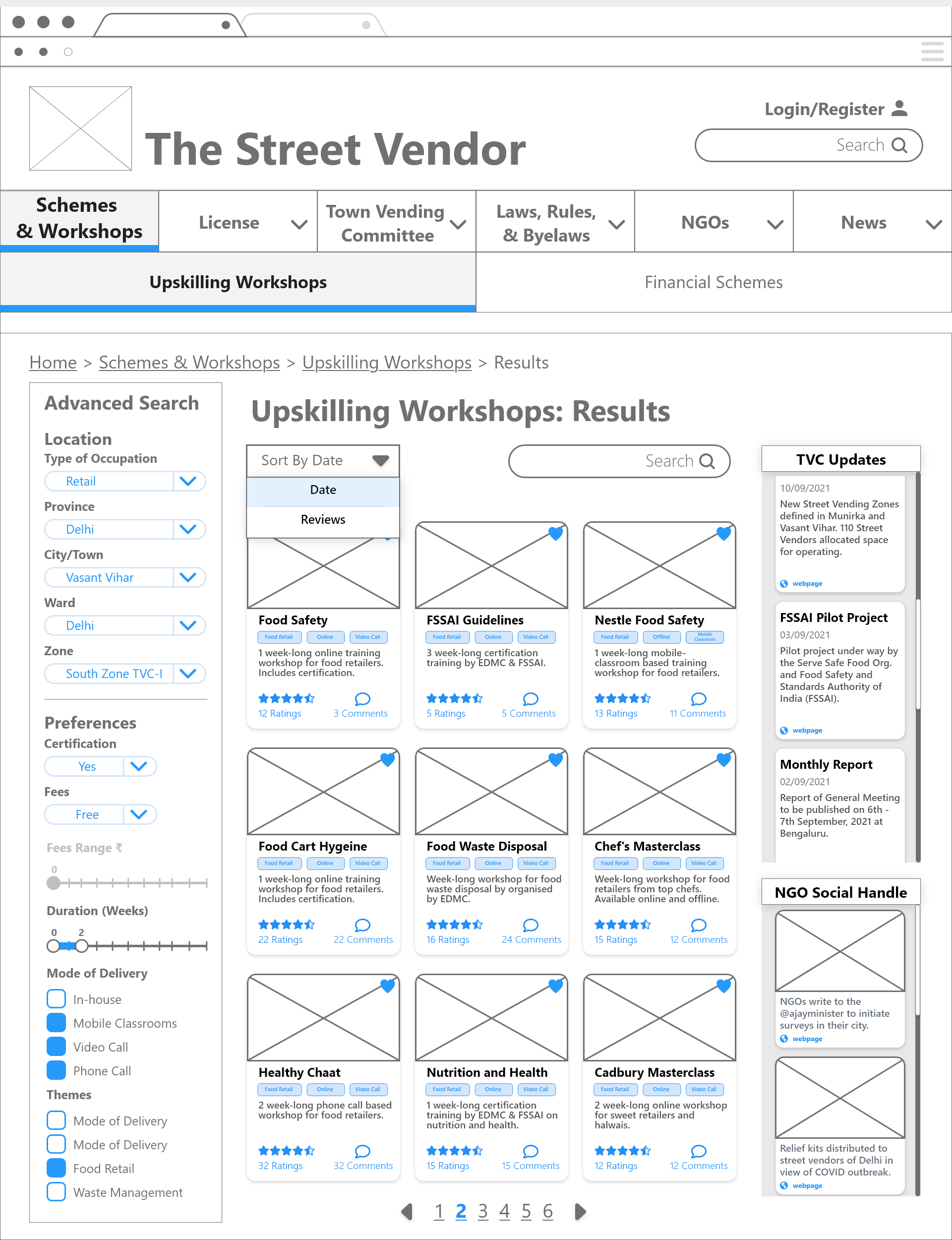
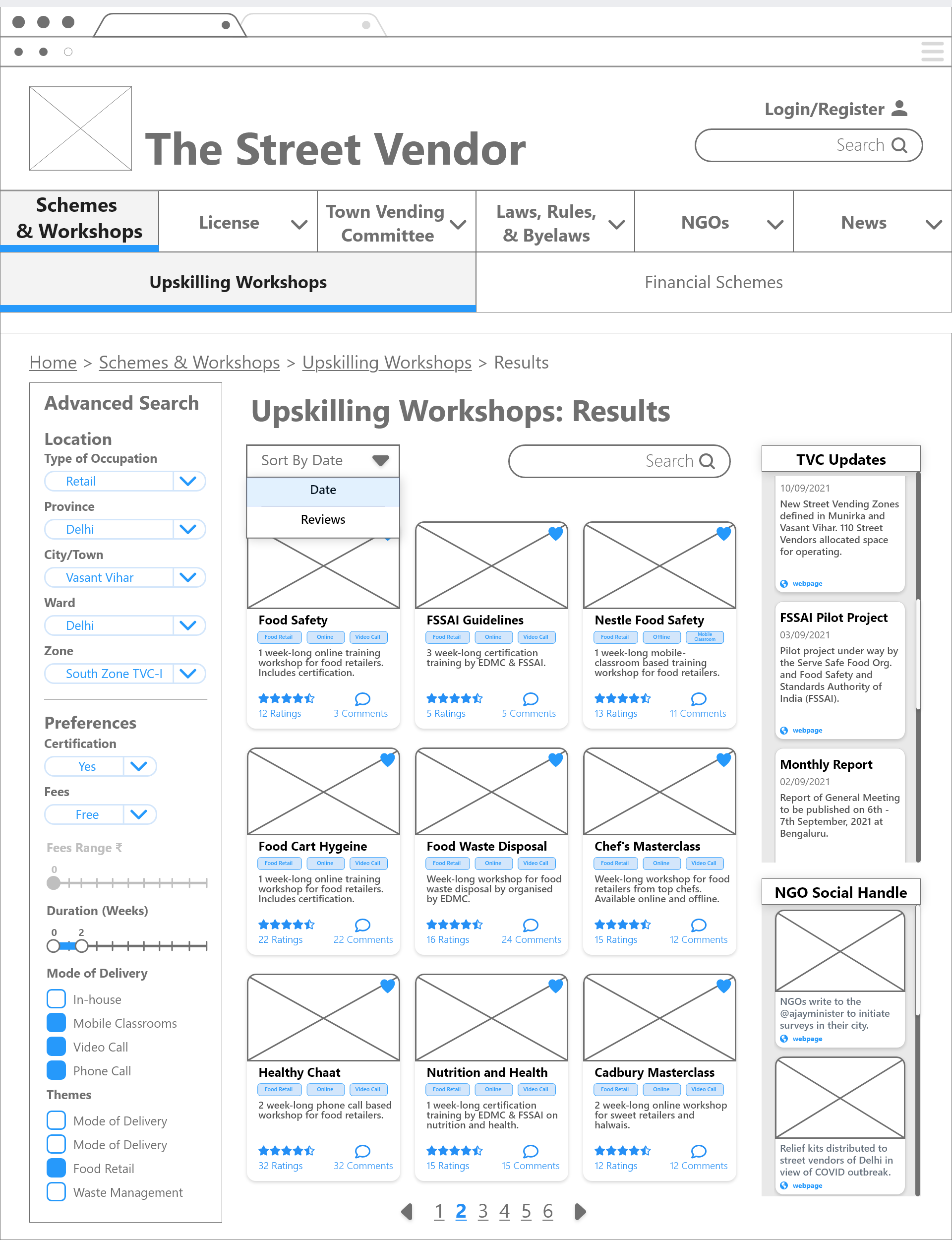
Wireframe 2 | Workshop Results Page
‘Upskilling Workshops’ Results Page supports faceted search and filters under ‘Advanced search’ panel. It also supports contextual search i.e., direct search by keyword from within listed items. The results are paginated to allow for careful navigation. The page also links contextual information such as town vending committee updates and NGO social handle if the location has been input. This helps bring in updated information directly associated with vendor’s area and occupation.
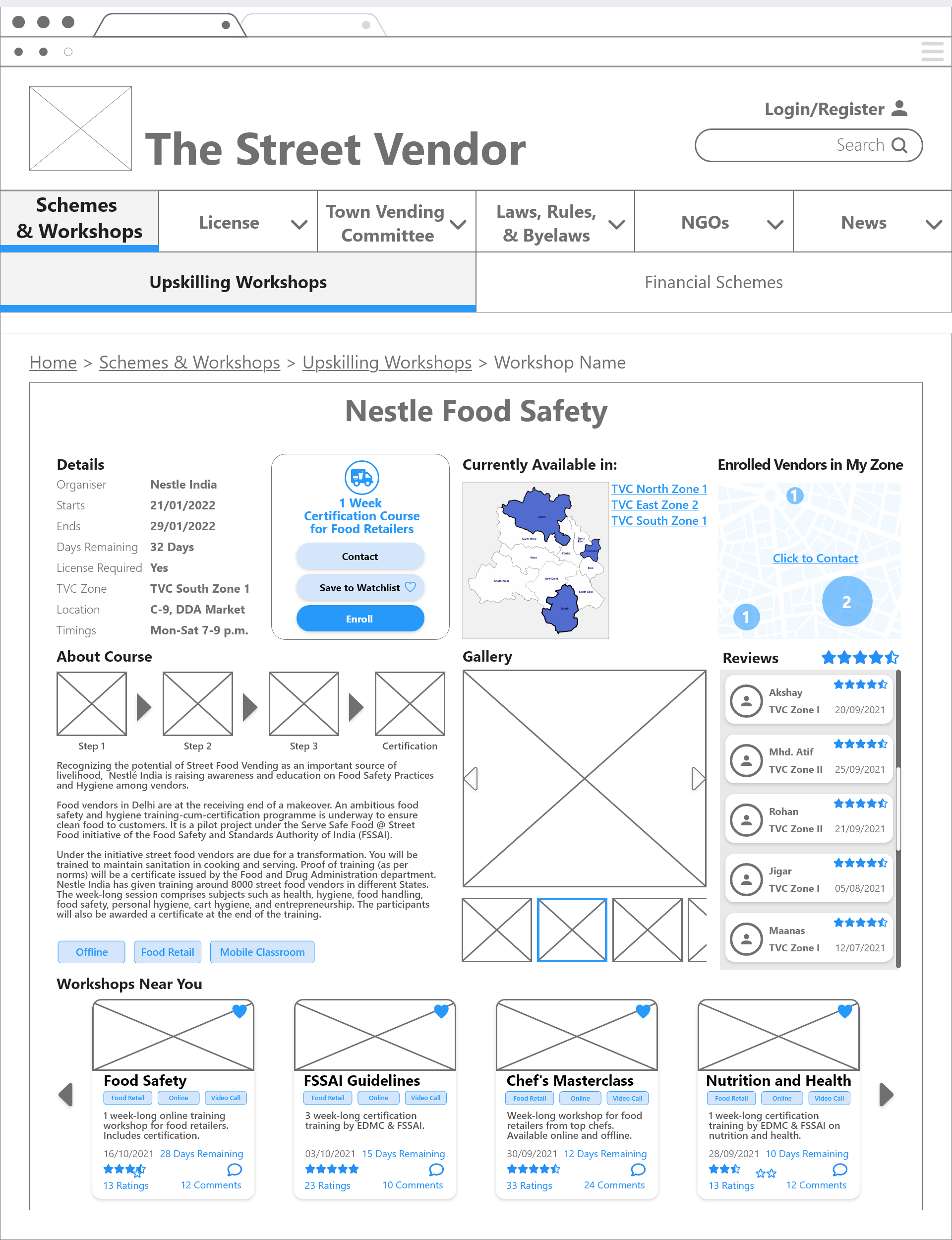
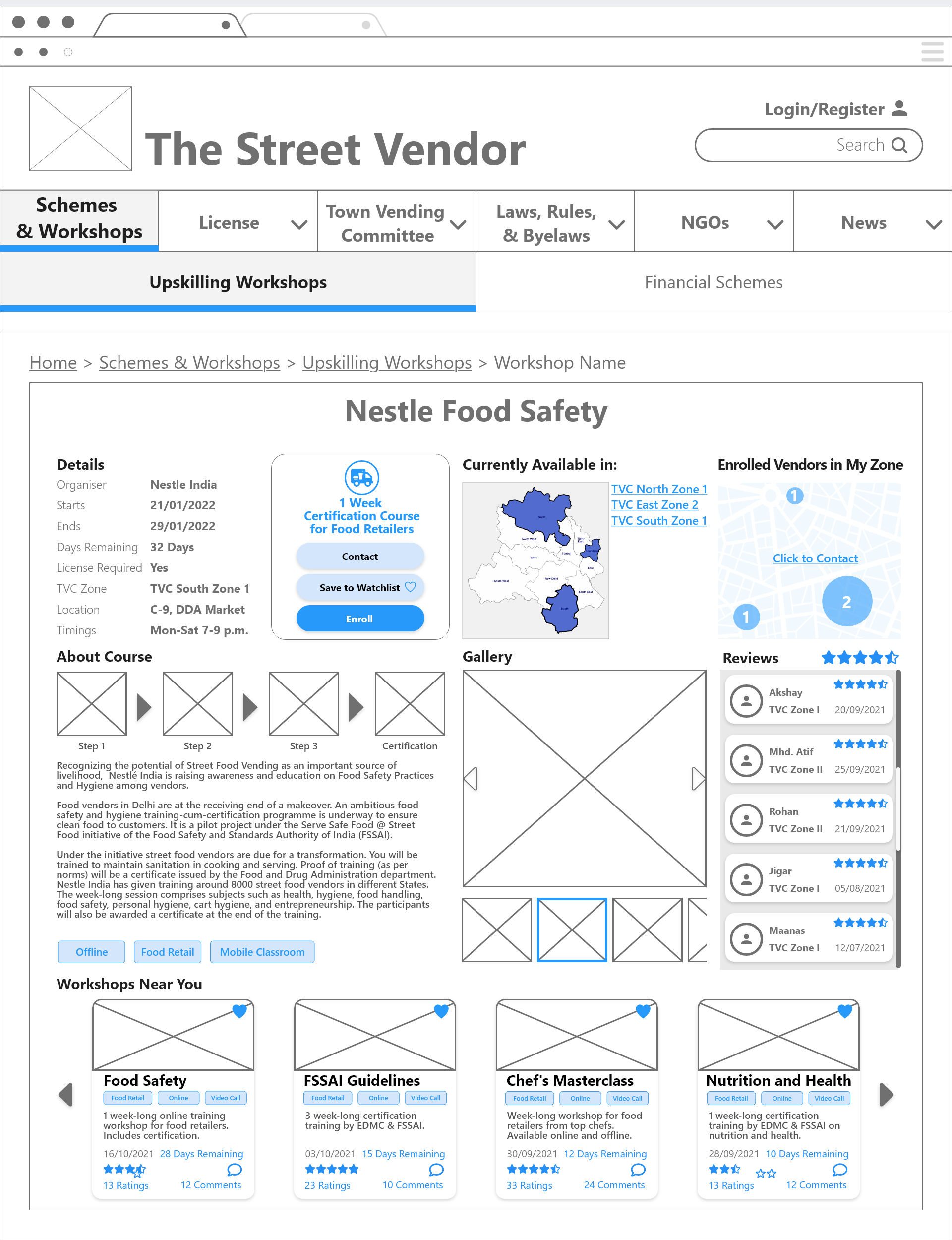
Wireframe 3 | Workshop Page
The workshop page provides specific information (i.e., specifications, image gallery, reviews). The design seeks to leverage the social network of street vendors (identified during interviews and deemed missing in the wireframe evaluation) to promote workshops by giving information such as other zones the workshop is available in. The page also allows user to connect with street vendors in their zone who have previously enrolled for the same workshop. The evaluation also highlighted organiser’s contact information as critical information prior to enrolment. The page reflects breadcrumbs in addition to the tabbed navigation that enable user to trace their way back a task (Caddick and Cable, 2011). The page houses recommendations that are tied to the user’s location of occupation and type of occupation.
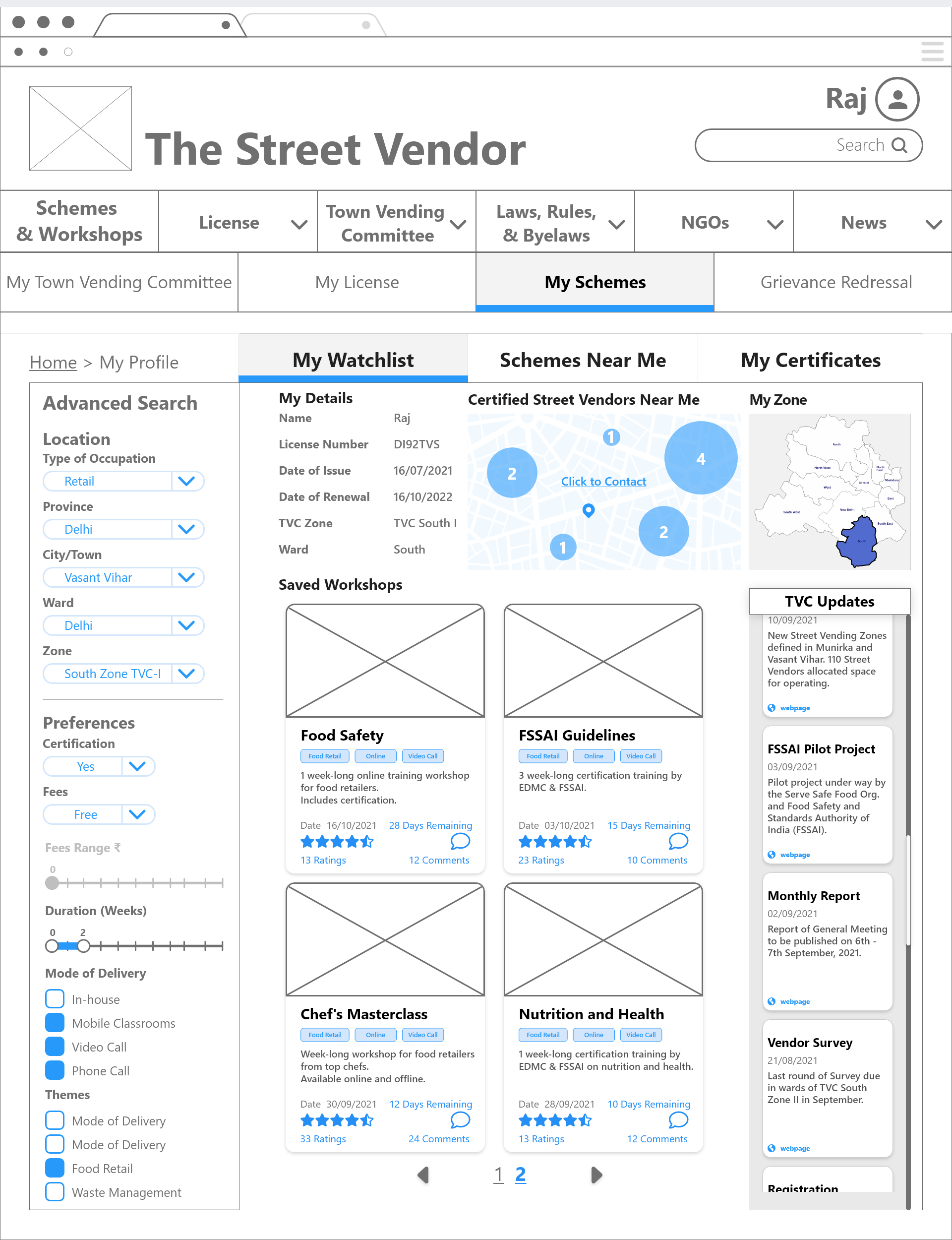
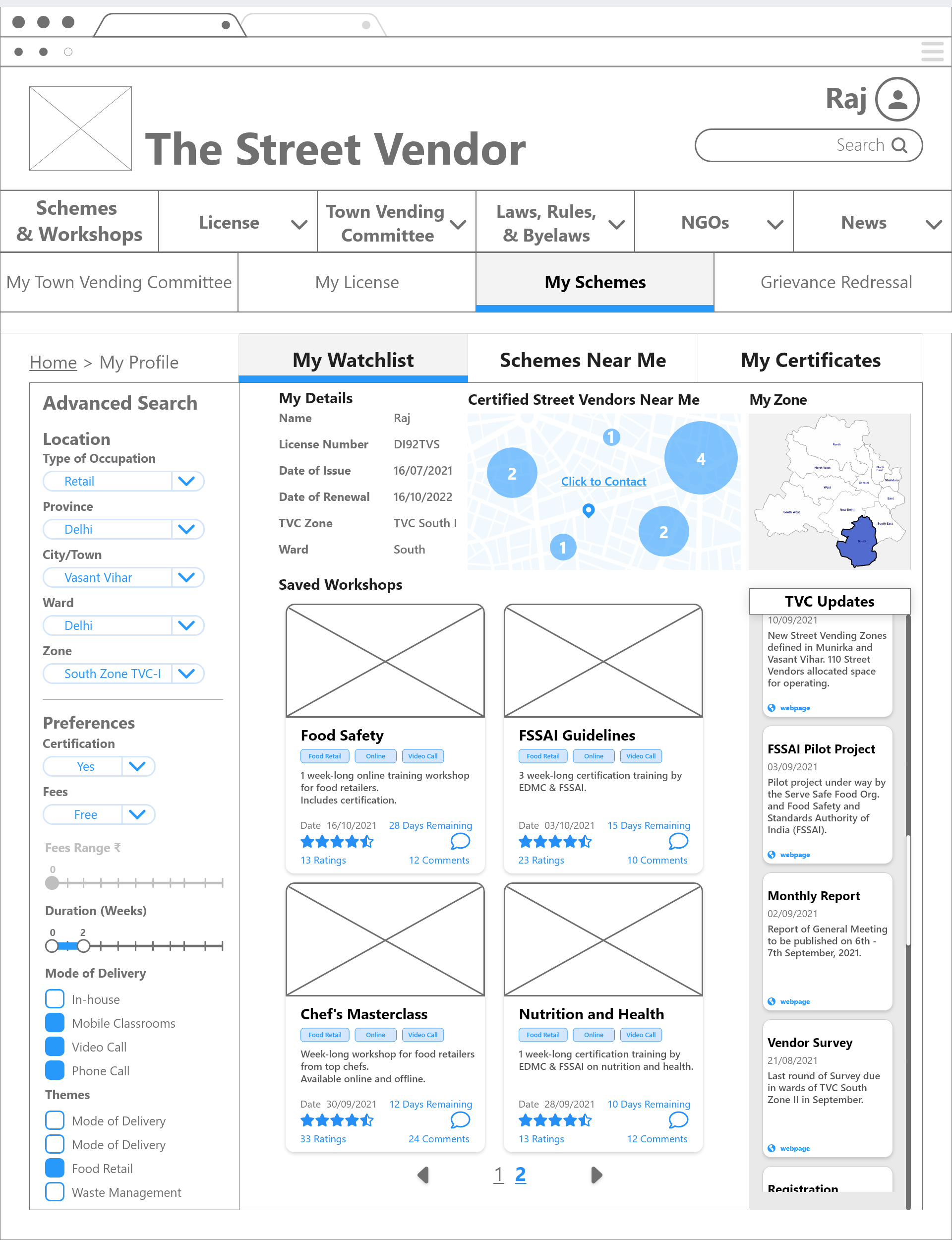
Wireframe 4 | My Watchlist
The watchlist page is accessible to registered users upon logging in. It allows user to save schemes (financial or upskilling workshops). The page provides personal information (such as license details, ward, and street vending zone etc.). The tabbed navigation allows for discovery of new schemes through suggestions under ‘Schemes Near Me’ tab. The utility navigation therefore supplements search and discovery outside of main navigation while providing contextual information linked with user information such as location, occupation and saved schemes.
GOING FORWARD
The intent of the project was to explore an information environment that could support informational delivery and simplify institutional functions. It sought to facilitate tech-literate users to extend services to street vendors. Going forward, deeper exploration into (1) better suited informational contexts (such as web-based application, or a mobile application, SMS-based services etc.), (2) information behaviour and (3) accessibility challenges associated with low-literate users is required. This can potentially inform solutions that do not assume or require handholding and are entirely accessible by street vendors.